
station 8: nathra
the beehive on the tip of the lion's nose

Today the moon alights in al-Nathra, the 8th lunar station. It’s been a while since I wrote one of these essays on the lunar stations—I’ve been thinking a lot about how I approach it.
The lunar stations (also known as the lunar mansions) have been, ever since I first became interested in astrology, one of my favorite topics. They’re so mysterious and entrancing and I’ve gathered anything I can get my hands on to learn more about them.1
I feel like the stations’ big moment is still building and I really want to help it come together, especially as system for connecting with their indicator stars.
Writing about the topic just feels very overwhelming. There’s so much rich information out there but so little of it is well-known or accessible. It feels like there’s an incredible amount of background foundation required before they really click for people (myself instead).
For this reason, I’m putting together a reference document introducing all 28 stations in one go.
It will include my research on:
Detailed info about each station’s name(s) in English and Arabic
All of their indicator stars
Their key significations and correspondences
Magical and electional uses
I’m thinking of it like a starter kit for those who want to start practicing with the system themselves. Hopefully I’ll have it done by the end of the summer!
Until then, here are some much more detailed thoughts I’ve prepared on Station 8: al-Nathra:
Some Nathra correspondences
Tropical coordinates: 25º05 Cancer - 7º57 Leo
Letter: ح ḥā’
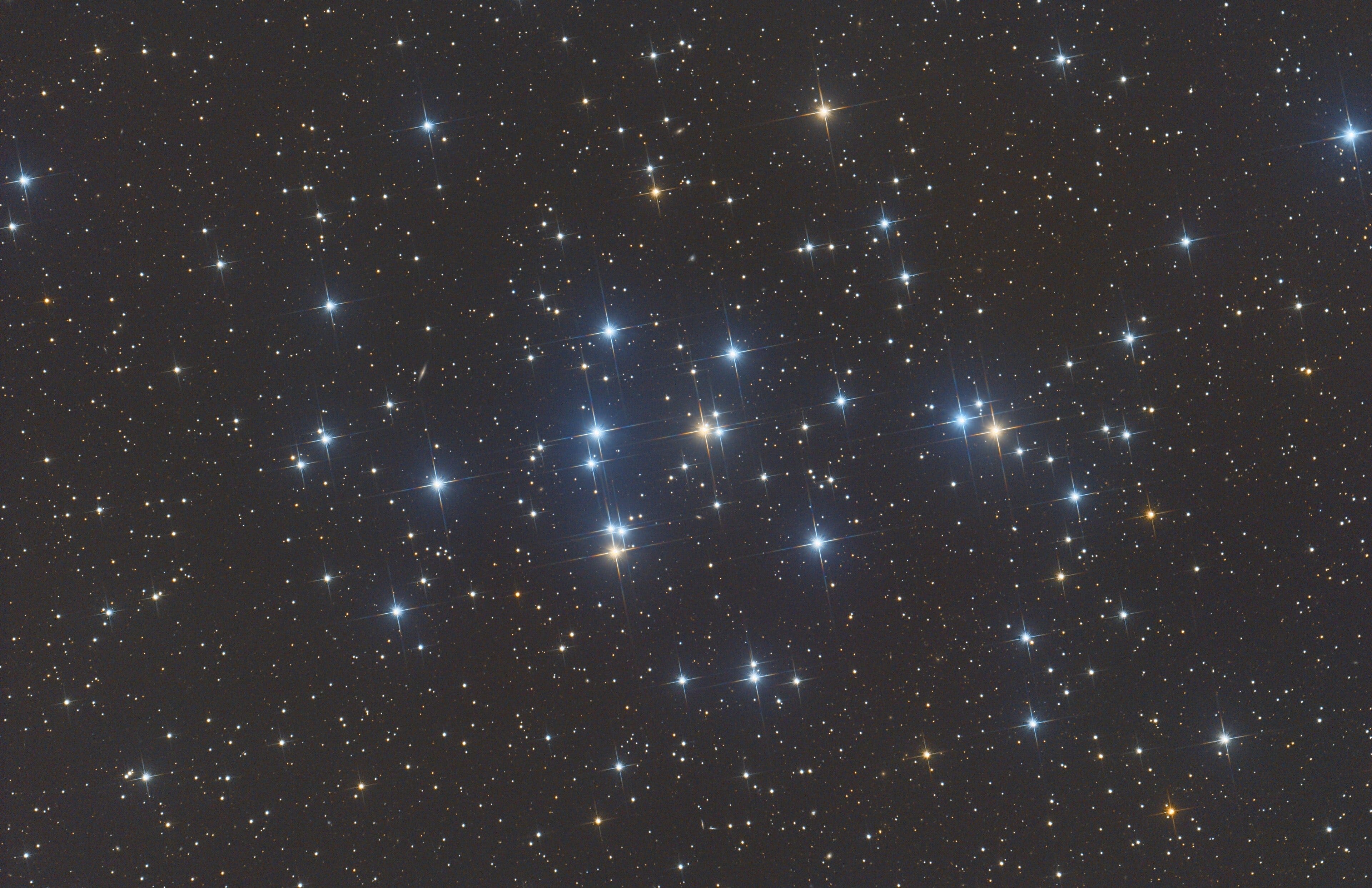
Indicator: This is the station of the Cancer constellation but especially Praesepe, the Beehive Cluster. Also δ Cancri (Ascellus Australis) and γ Cancri (Ascellus Borealis).
Plants: There is a general association with medicinal and poisonous plants, especially those which act on the lungs or are astringent. Costus and pomegranate are named specifically by al-Biruni. Some more ideas I’ve been experimenting with are mullein, lobelia, angelica, hyssop or ginger.
Substances: All bee products (honey, wax, propolis etc). Seashells and other coverings. Perhaps other things from the sea or waterways in general.
Animals: Bees and crabs. Consider also other crustaceans and stinging insects (especially those stinging insects that pollinate). Following the invocation of the Moon, perhaps also wolves?
Angel: أقاريس Aqārīs

In Arabic, the nathra refers to the philtrum. Considering that we are currently exploring the stars of al-Asad, the pre-Islamic Arab constellation, this refers to the philtrum of a lion rather than a human. These stars represent the lower face of the celestial lion and are made of the main stars of the Hellenistic Cancer costellation.

Station 8 has quite an intense energy in my opinion but, to me, it doesn’t seem malefic exactly. In fact it can be encouraging and nurturing—just make sure you don’t try to turn back from the encouragement it gives you. I really like the way that al-Buni puts it: its spirit provokes. It goads. It can be used for aggressive protection and offensive applications. If you start a fight under this station, you will win. Its energy can be polarizing. Picatrix and the later Latinate traditions view it mostly positively (and it is considered a benefic nakshatra in Indic astrology), however al-Buni tells us it’s not overly good. We should work on our goals but keep our wits around us under this one. Its spirits are cool in temperament and bring mixed fortune.
Some key symbols of Nathra are:
The sea, waterways and rain and every aquatic thing they produce
Breath and the organs of breath (the sinuses, the airway, the lungs), particularly their health
The spirit of Anankē • Necessity: urging and growth, the things that push us forward whether we want it or not
The victory that ensues if we stay the course—and the misery that comes from deviating from it
Honey, beeswax and every other product of apiculture
I actually have had no experience with this station aside from the research I’ve undertaken for this project. When I began my research into the fixed stars, my eye was immediately drawn to Praesepe due to its unique name and status as the most notable “star” in a zodiacal constellation while not being a star itself (more about that below). Despite this early interest, it wasn’t until I undertook my cycle of manzil rituals that I really understood anything about this cluster of stars the minimal tidbits written about it.
In 2023 the Moon did not feature the Nathra prominently in any lunation. Of the days that year that the Moon was in the 8th station, I selected December 29th with geomancy as the best day to perform my gnosis gathering ritual.
Each year my spouse and I made the journey from the town we’d settled in back to our hometown to spend Christmas with our birth families. Each year it was a difficult trip, full of challenging emotions for us all but especially me. This year was particularly complicated because my spouse fell ill as soon as we arrived in town and spent most of the days following Christmas in bed. That year on Christmas evening I had had to have a particularly difficult conversation with my mom, while my spouse was sick in the other room. We stayed up talking all night, nearly til the sun rose. Looking back on that conversation, I think it was the moment that our relationship really leveled up. In that conversation, we began taking steps towards developing a meaningful mother-daughter relationship as adults, rather than the unequal relationship between a child and their parent.
In the moment though, it just felt like a really hard conversation.
When the waning Moon culminated a few nights later in the earliest hours of the 29th, I performed my ritual in the spare room of my mom’s house. By the light of a single small candle, I quietly invoked the Moon and welcomed in the spirit who rules the 8th station.
a sunshower. swarms of glistening sweat bees emerge from their underground nests. the sound of sticky fingers. a wolf licks its lips. a bee drinks my sweat.
I AM the buzzing bees
i am the fingers of necessity
poking prodding stinging towards success
i am the patrolling wolf, attendant of the gods
i am hungry
i am aching with desire
and urgency
gather around my nest, little wolves
and let me put something sweet in your mouth.\
The presence of Aqārīs felt firm. The images it brought me were extremely rich in sensation. I perceived her to be feminine but it was the solid femininity of an anglerfish rather than the delicate femininity of a doe. She was not cold per se, but rather cool. She exuded solid determination—I’d hate to have her against me. Despite me invoking her in the depths of the winter, the scene she presented me was summery. Rather than idyllic, it was something else. The way the bees buzzed and the wolf paced seemed slightly menacing, yet the shower of rain was still refreshing. This station’s nature is shrouded in contradiction.
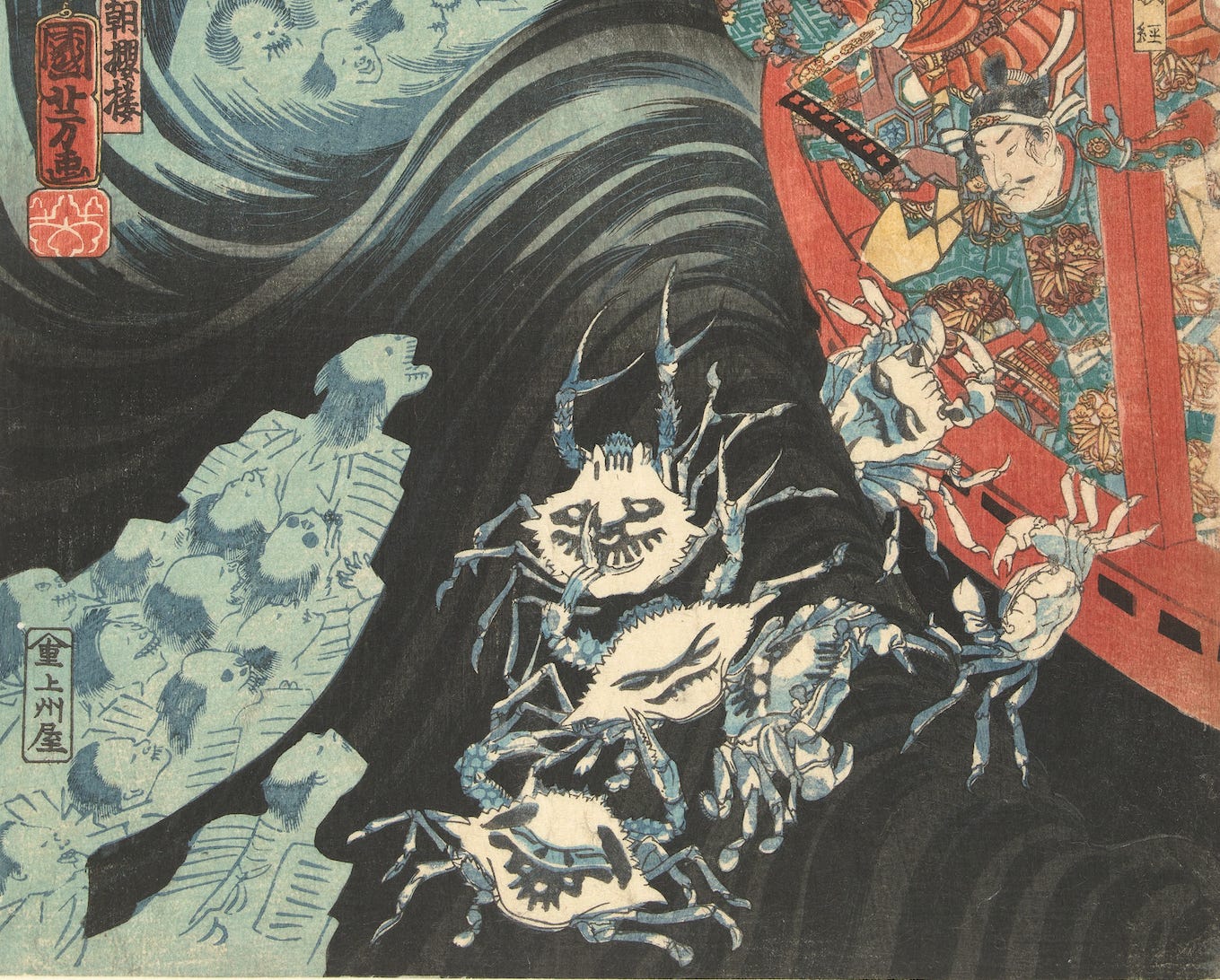
The first work of art I selected to represent this station, depicted above, shows a group of samurai fighting off a storm of crabs created by the ghosts of vanquished warriors from a rival clan. The ghastly creatures of the ocean seek vengeance on behalf of the defeated ghosts who return to the land which has been conquered. What is the aftermath of victory? The full painting can be seen here.
During the days of the ritual for this station I came across an album I hadn’t listened to in years, “direct line to My Creator” by duendita. The most Nathra song, I think, is “i’ma get you”:
Baby believe, I’ma get you before the grim reaper get me
I’ma come through, I wanna see that ass on bended knee
Beg to me, you know I set you free
Grew a garden for you, that’s what you meant to me
thoughts on al-nathra • النثرة
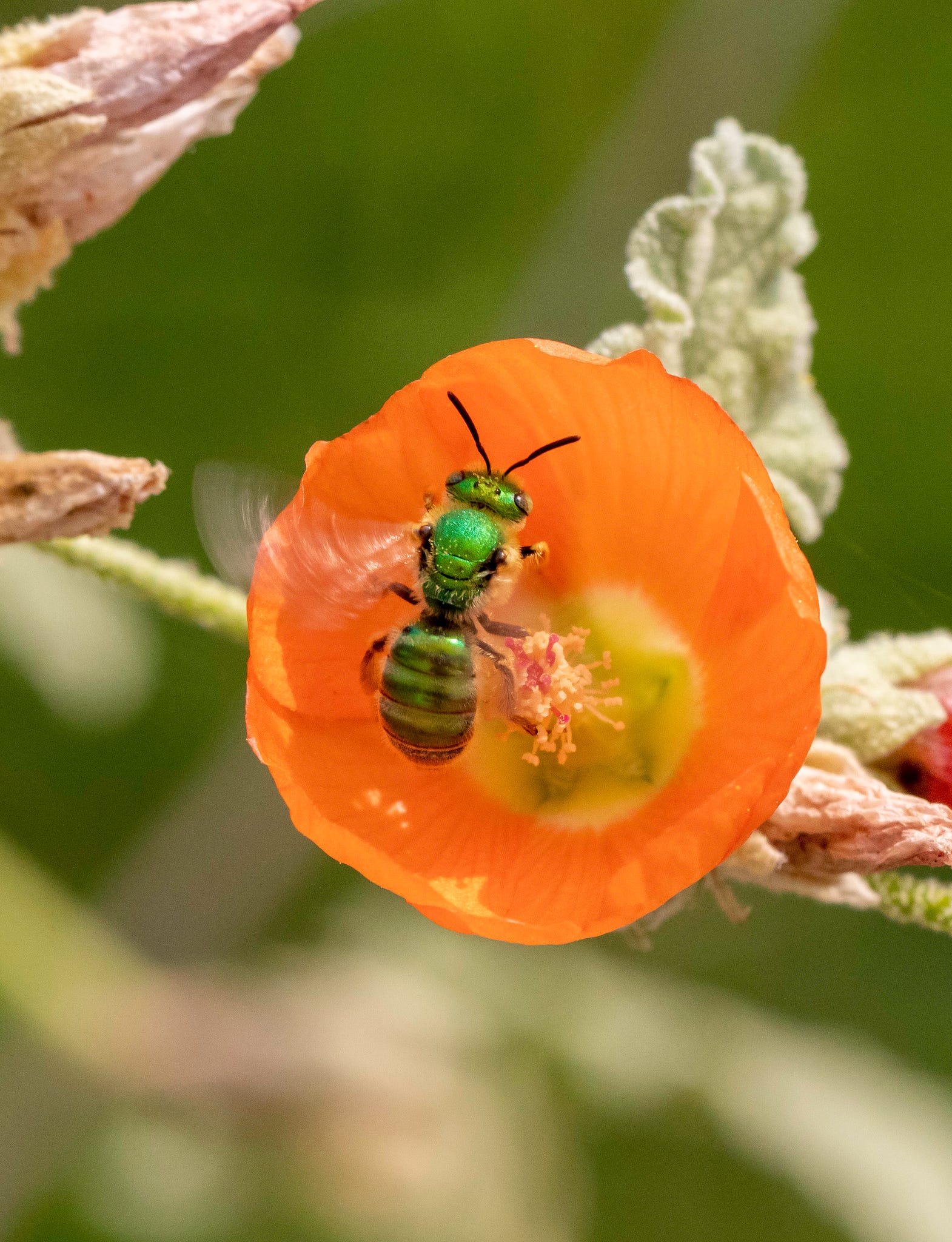
Considering that this is the station of the Beehive Cluster it makes sense that bees and stinging insects would be a good place to start. Bees are one of humanities oldest companion species, domesticated thousands of years ago for their wax and honey.2 Their presence in human culture and mythology is almost too much to sum up in a few short sentences but any angle of approach to them will be suited to your work with The Beehive. But did you know that wasps are important pollinators too? So are mud daubers and many other stinging insects.
In Greek culture, bees were often seen as chthonic spirits. They build their hives in caves and can emerge in a swarm when provoked. Portals to the underworld could be found deep in caves and so the host of flying creatures that emerged from these caves could feasibly have come from the underworld. The spirits of the dead themselves were sometimes depicted as small flying insects and perhaps this is what came swarming from disturbed caves.3
Following some of this lore, I came across Via Serpentis’s essay on the famous Maskelli Maskello formula in the Greek (and Egyptian) Magical Papyri. There’s an interesting line of thought to be explored between bees, the Idaean Dactyls, goetia, the Maskelli Maskello formula and, perhaps, Nathra. These topics are rich and nuanced; I’ll let his article stand for itself. For my own part, I have explored timing my work with these practices while the Moon occupied the 8th station as a way of exploring its pattern. For those who are also engaged in such practices, this may also be a fruitful line of experimentation.
The prompt spirit of Necessity is potent when station 8 is activated. The fingers of Necessity goad especially sharply under the Beehive. This opens an entire field of magical experimentation that I have yet to fully explore myself. Necessity is one of key components of the way fate and destiny were conceived in antiquity. This energy can be found in the binding, restraining, compelling and protective magic of that age, but also imagery of fate prodding us forward.
More on that another time.

Al-Buni reports to us in his rhyming aphorism that “when Nathra rises, the bee rejoices at plenty, but cows give not a drop to drink.” We have our familiar bee imagery but also the cows’ milk running dry. The way I understand dairy cows, they typically stop producing milk in the final stage of pregnancy right before calving season, which brings us to another interesting symbol I’ve encountered: that of Leto, the mother of Apollo and Artemis. She is depicted in the second painting for this essay, holding her son Apollo. As her story goes, during the final stage of her pregnancy and while going through labor she was harassed and tortured by a jealous Hera. To me, Leto reflects the extremely solid, determined femininity of the 8th station. Bees symbolized the cycle of life and death and childbirth and the final stages of pregnancy similarly reflect that cycle as well. Again: much to consider.
The final symbols that come up with this station are related: that of the breath and the lungs of breath, and that of the sea, waterways and the rain.
Al-Buni gives us costus as one of the incenses associated with al-Nathra. This incense, called qusṭ • قسط in Arabic, is mentioned numerous times in the section on medicine in the hadith collection Saḥiḥ al-Bukhārī. Kitāb al-Ṭibb • كتاب الطب (the Book of Medicine) teaches us that costus has a specific action on the lungs and airways, being prescribed for treating tonsillitis, pleurisy and throat aches. While costus isn’t a medicinal herb I am often able to find in my region, I have used elections of the 8th station to prepare medicines for the lungs, the throat, the mouth and the sinuses. Mullein and angelica are used for these purposes in my area, and I have begun tentatively using them in incenses for this station as well. That’s something you should explore too—Aqārīs seems to like them.
The connection between Nathra and water isn’t immediately obvious to me, but it does come through in our traditional sources. As I mentioned above, the veiling of Praesepe is used for predicting rain. Liber Lunae, a medieval grimoire of lunar station magic, tells us that the 8th station is the best for workings involving water, ships and floods. Ashmole 396, an English Renaissance-era treatise on elections for the lunar stations, tells us it is good to travel by water under Nathra because it will ensure your steady return—and that if it rains under this station the rain will do good. This water angle is something I have yet to really explore in much detail but it’s something we should keep on hand. Water magic is an extensive and diverse topic. When in doubt, work it under the auspices of Aqārīs.
until the Moon alights here again,
Shuly Rose
shulyrose.com ☾ what i’ve been up to
I have recently been thinking about that fact that I have a paran between Mercury and Spica, the indicator of Simāk, the 14th lunar station. Apparently this is good for research :)
I decided not to go into my detour on beekeeping in Ancient Egyptian culture. It’s a topic that deserves its own attention some day in the future. For now, let me recommend a book and a series of videos from its author on apiculture in Ancient Egypt:
Kritsky, Gene. 2015. Tears of Re: Beekeeping in Ancient Egypt. Oxford University Press.
Much of the lore of Greek chthonic bees comes from this:
Cook, Arthur Bernard. 1895. The Bee in Greek Mythology.